
Awareness, Opportunities & Growth
I am so fortunate to be the mother of three amazing sons. And while I could endlessly brag about each of them, this article will focus on my middle son, Bennett Quinn, who is twelve years old. Bennett, or BQ as we like to call him, is smart, hilarious, athletic, curious, handsome, witty, etc. Many of the same adjectives I use to describe his two brothers. Yet one way Bennett differs from his brothers is that he was born with an extra copy of his 21st chromosome called Trisomy 21, more commonly known as Down syndrome. Individuals born with Down syndrome experience a range of intellectual and physical challenges which are unique to each person.
October is Down syndrome awareness month. Before October of 2010 (Bennett’s birth year), I did not know there was a month dedicated to celebrating and advocating on behalf of individuals with Down syndrome. But since then, I have learned so much about the community my family is proud to be a part of and the issues that are worthy of recognition and celebration.
Like any community, many issues around Down syndrome are important topics of discussion. The one I would like to focus on in this article, however, is inclusion. After having a child with Down syndrome, I quickly realized that inclusion would be an issue that would be of paramount importance to Bennett and our family for the rest of our lives. Inclusion would shape Bennett’s life from infancy to adulthood, and his experience in school, extracurriculars, community involvement, and beyond would be wholly dependent on inclusion.
Perhaps the most critical thing for people to understand about inclusion is that it cannot be truly achieved without first understanding and embracing the reality that people with an extra copy of the 21st chromosome and those without an extra copy are so much more alike than they are different. Over the years, I have unfortunately encountered many misconceptions and stereotypes, often rooted in good intentions, that turn authentic and complex people into Down syndrome caricatures. People with Down syndrome are first and foremost people. And like all people, they are different from person to person. They experience the full range of emotions each day – like we all do. As many stereotypes portend, they are not simple and carefree bundles of joy who are always happy. As the mother of a very stubborn and opinionated pubescent 12-year boy, I can most definitely tell you that outdated image could not be more wrong.
So, understanding the critical foundation that inclusion starts with awareness, I want to talk about my journey regarding inclusion and how I have evolved over time. What I thought inclusion would or should be when Bennett was an infant and into early childhood had nothing to do with the reality of who he has become as a person and his desires and needs. Like many new parents of a child with special needs, my early thoughts about inclusion were driven by fear. Would Bennett be excluded from aspects of daily life that shape childhood experiences? Would he be segregated in school and miss out on important social and developmental opportunities?
Thankfully, most of our family’s fears about inclusion lessened over the years as we engaged with so many wonderful professionals working in education and therapeutic development. Bennett has been an active and visible member of his various schools since his first days of preschool. This is continually evident anytime I am with him at school or at an after-school activity (the word “rockstar” comes to mind). And although we always actively advocated for Bennett’s full inclusion in educational settings, we have been so grateful for his opportunities and access.
As stated before, as our family watched Bennett grow and mature, our understanding of inclusion has evolved. First and most importantly, we now know that presence does not equal inclusion. Being in a general education classroom in and of itself does not equal inclusion. Rather, seeking out meaningful interactions and understanding Bennett’s individual needs or wants is true inclusion. For example, Bennett may not want nor benefit from sitting in a 6th grade math class, but he certainly benefits from many other access points in the general education setting. It is also so important to be aware that his needs and wants may very well change over time, and further understand and embrace the idea that what works for Bennett may not be the best plan for someone else with Down syndrome. Again, every person is different.
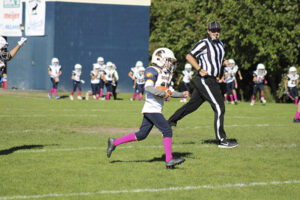 To end, I would like to share a recent example of true inclusion. Bennett expressed interest in playing football and has been able to participate on his 6th grade football team this season. We didn’t know what to expect. At his first practice, his coaches made a concerted effort to involve him in the drills and instruction, and afterward gave him an effort award in front of the team. That day we knew we made a good decision. This past weekend, after weeks of practice and going to games to cheer on his teammates, Bennett’s experience culminated in scoring a 30-yard touchdown to end the game – to significant fanfare and celebration. The efforts his coaches, teammates, managers, and even the opposing team made to ensure Bennett had a monumentally meaningful experience cannot be overstated. Those people are heroes to our family and should be celebrated during this month of awareness as well. Their inclusion efforts didn’t just benefit Bennett. By the reactions, the heartfelt words, and the scene of overwhelming joy, it was clear that Bennett’s inclusion impacted and benefited every person in attendance. That is my final thought: A more inclusive society benefits everyone and thus should be something to continually strive for.
There is no doubt that awareness, opportunity, and inclusion for people with Down syndrome have grown exponentially in the past several decades. My hope for Bennett, and all his fellow members of the Down syndrome community, is that similar progress is achieved in the next several decades as he matures into an important member of the community at large.
Happy Down Syndrome Awareness month!
Written by:
Corey Starmer
Event Planner – MPHI Education & Training Services